Syllabus
This course introduces students to 3D game art production using Blender and Unreal Engine. Year 2 (Game Art & Design I) emphasizes asset creation, environment assembly, and professional workflows. Semester 1 focuses on Blender modeling and texturing. Semester 2 transitions into Unreal Engine and full environment building.
Canvas, this site, and Jupiter are your three main tools.
- Canvas → quizzes, classwork submission, and class discussions.
- cte.levelarts.studio → project descriptions, notes, readings, and resources.
- Jupiter → grades (synced as assignments are graded in Canvas).
There is no excuse for lost passwords — every student must maintain access to all three systems.
Course Information
Course Description
Game Art & Design I introduces students to Blender and Unreal Engine as industry-standard tools for creating game-ready assets and environments. Students learn prop modeling, UV mapping, texturing, lighting, and exporting workflows, then assemble assets in Unreal to build environments. Transferable skills—teamwork, communication, problem solving—are emphasized. This course prepares students for the Year 3 capstone: Game Art & Design II.
Learning Outcomes
Students will:
- Model, UV unwrap, and texture low-poly props in Blender.
- Create presentation renders and export assets for Unreal.
- Assemble scenes in Unreal with lighting, landscape, and props.
- Apply simple Blueprints for interactive elements.
- Document and present work in a portfolio-ready format.
This class officially has no assigned homework, but there may be times when you need to work outside of class to complete projects. It is not expected that students have hardware at home capable of running Blender or Unreal. This makes efficient use of class time critical — all major work must be done in the studio.
Weekly Points System
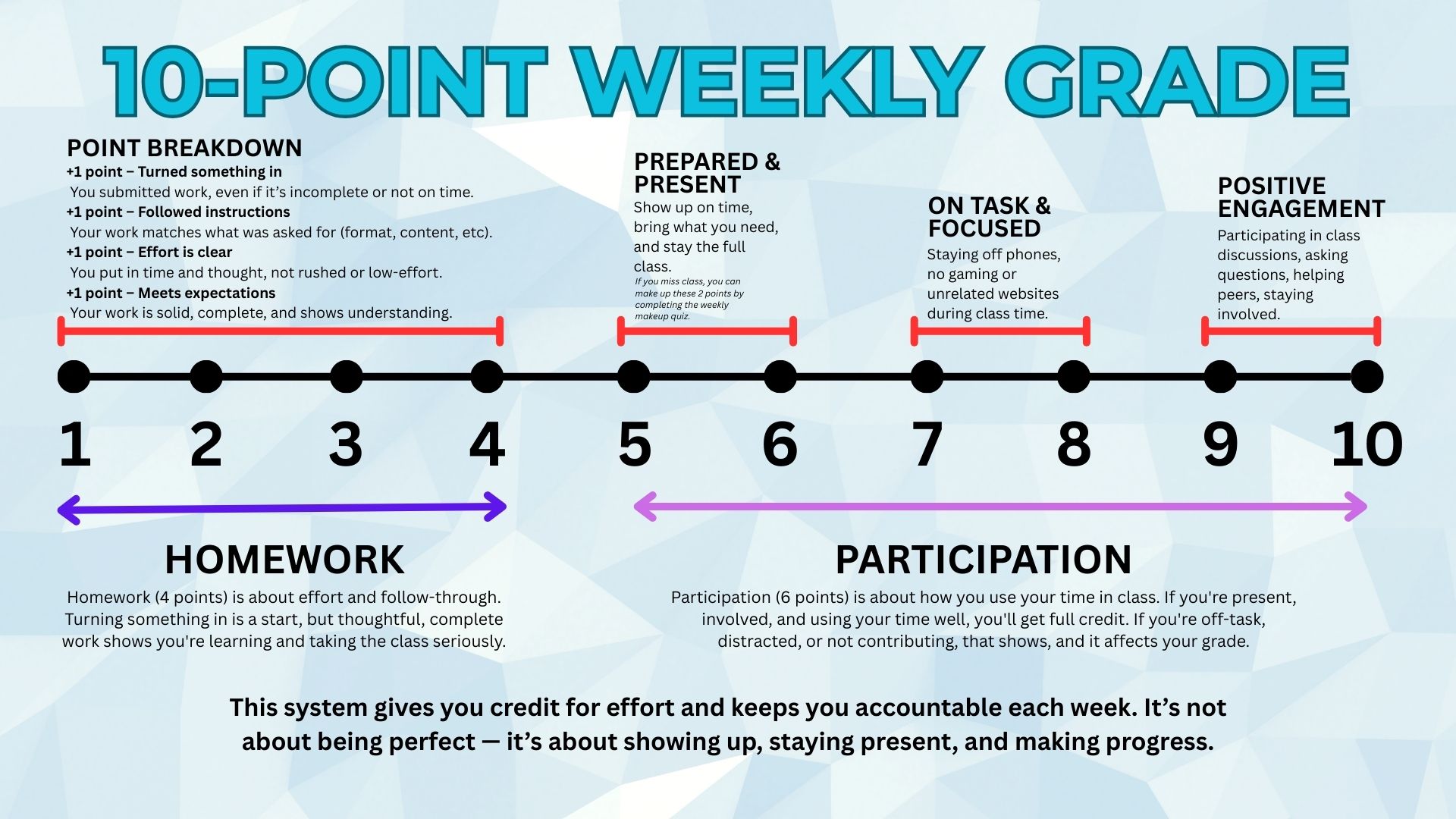
10-Point Grading System Breakdown
Every week you can earn 10 points. These track both participation and classwork.
Participation
- Prepared & Present (2 pts) — arrive ready with materials, logins; stay full class.
- On Task & Focused (2 pts) — use studio time to progress; limit distractions.
- Positive Engagement (2 pts) — collaborate respectfully, contribute to discussions, help peers.
Classwork
- Turned Something In (1 pt) — submit Blender/Unreal files, renders, or worksheets by deadlines.
- Followed Instructions (1 pt) — matches project specs.
- Effort is Clear (1 pt) — steady progress, not rushed.
- Meets Expectations (1 pt) — quality meets the standard for moving to the next step.
Classwork must be submitted within the unit deadline; late work loses points.
Final Projects
- Semester 1: Prop Project in Blender (Unit 3)
- Semester 2: Environment Project in Unreal (Unit 6)
- Each project = 100 points, worth 30% of your semester grade.
- Final projects include concept art, 3D models, renders, and presentations.
- Graded with detailed rubrics aligned to AME standards.
but you must demonstrate mastery on the final project to pass the pathway.
Weighting
| Assignment Type | Points | Weight | Due Date |
|---|---|---|---|
| Weekly Points | ~150 | 70% | Weekly |
| Final Project | 100 | 30% | End of Semester |
Grading Scale: A = 90–100, B = 80–89, C = 70–79, D = 60–69, F < 59
Check Canvas for submissions/quizzes, this site for resources, and Jupiter for grades.