Syllabus
This course is the capstone year of the Game Art & Design pathway. You will work in teams to plan, build, and deliver a polished vertical slice of a game level. Emphasis is on production pipelines, collaborative workflows, optimization, and professional presentation. By the end, you will graduate the pathway with a finished portfolio project and showcase-ready work.
Canvas, this site, and Jupiter are your three main tools.
- Canvas → quizzes, homework/classwork submission, and class discussions.
- cte.levelarts.studio → project descriptions, lecture notes, readings, and resources.
- Jupiter → grades (synced as assignments are graded in Canvas).
Every student is responsible for maintaining access to all three systems.
Course Information
Course Description
Game Art & Design II is an advanced capstone course. Students work in production teams to design a game concept, create assets, assemble environments, and implement gameplay elements in Unreal Engine. The course emphasizes teamwork, project management, and portfolio readiness. It concludes with a vertical slice delivery and public showcase.
Learning Outcomes
Students will:
- Plan and document a project using a Game Design Document (GDD) and art style guide.
- Work in teams to assign roles, manage scope, and follow production pipelines.
- Prototype mechanics, art style, and workflows to test feasibility.
- Assemble a playable Alpha build with integrated assets and core gameplay loop.
- Apply polish, optimization, and marketing practices to deliver a Beta build.
- Present a final vertical slice with a trailer, cover art, press kit, and showcase pitch.
Starting Week 2, you will continue reflective journal work. Prompts connect directly to design thinking, production planning, or analysis of professional games/media. If you cannot complete the exact prompt, propose a substitute (reflection on past work, alternate game/media analysis, or your own design notes).
Weekly Points System
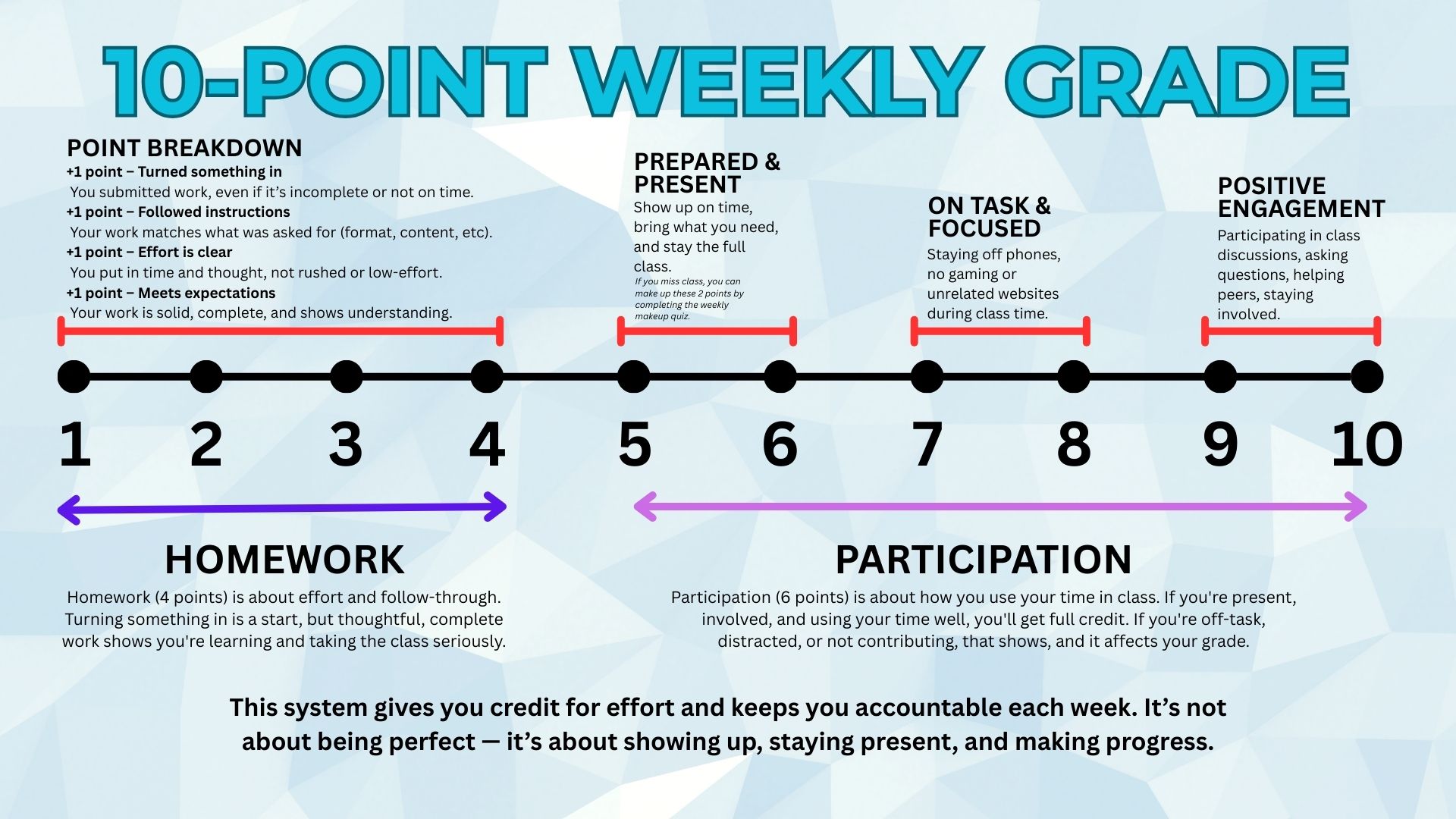
10-Point Grading System Breakdown
Every week you can earn 10 points. These track participation, effort, and homework, just as in earlier years.
Participation (6 pts/week)
- Prepared & Present (2 pts) — on time, ready, stay full period.
- On Task & Focused (2 pts) — work on assigned tasks, avoid distractions.
- Positive Engagement (2 pts) — collaborate, contribute ideas, use respectful communication.
Homework/Classwork (4 pts/week)
- Submitted (1 pt) — all work turned in.
- Followed Instructions (1 pt) — matches directions.
- Effort Clear (1 pt) — shows genuine attempt.
- Meets Expectations (1 pt) — demonstrates readiness for next step.
Final Projects
- 100 points each semester
- Semester 1 → Vertical Slice Alpha Build (Units 1–4)
- Semester 2 → Final Vertical Slice & Showcase Presentation (Units 5–6)
- Each project spans multiple weeks and requires documented planning, iteration, and presentation.
- Projects are graded using a detailed rubric aligned to AME standards and pathway expectations.
- Final projects = 30% of semester grade. Weekly points (~70%) alone can only earn a C at best.
Weighting
| Assignment Type | Points | Weight | Due Date |
|---|---|---|---|
| Weekly Points | ~150 | 70% | Weekly |
| Final Project | 100 | 30% | End of Semester |
Grading Scale: A = 90–100, B = 80–89, C = 70–79, D = 60–69, F < 59