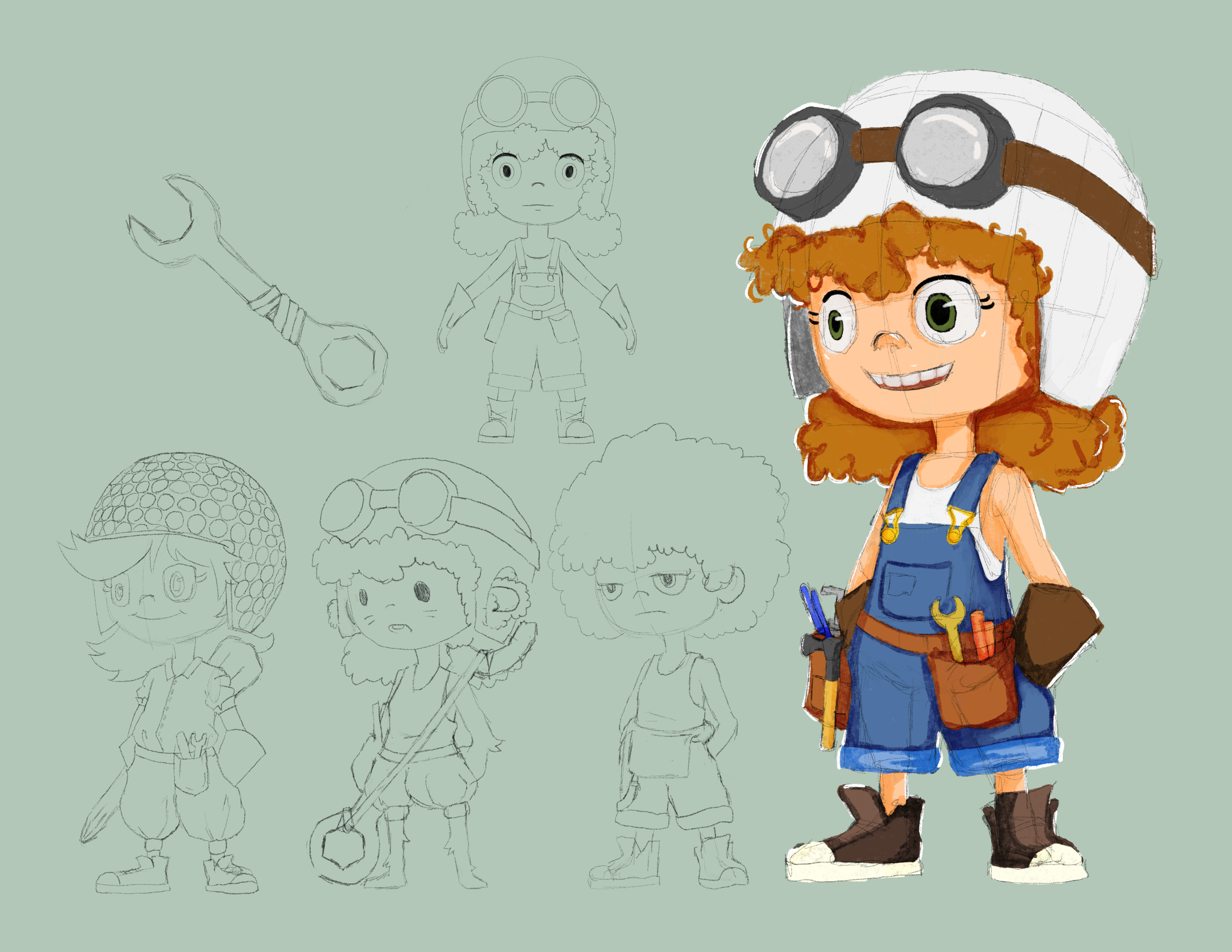
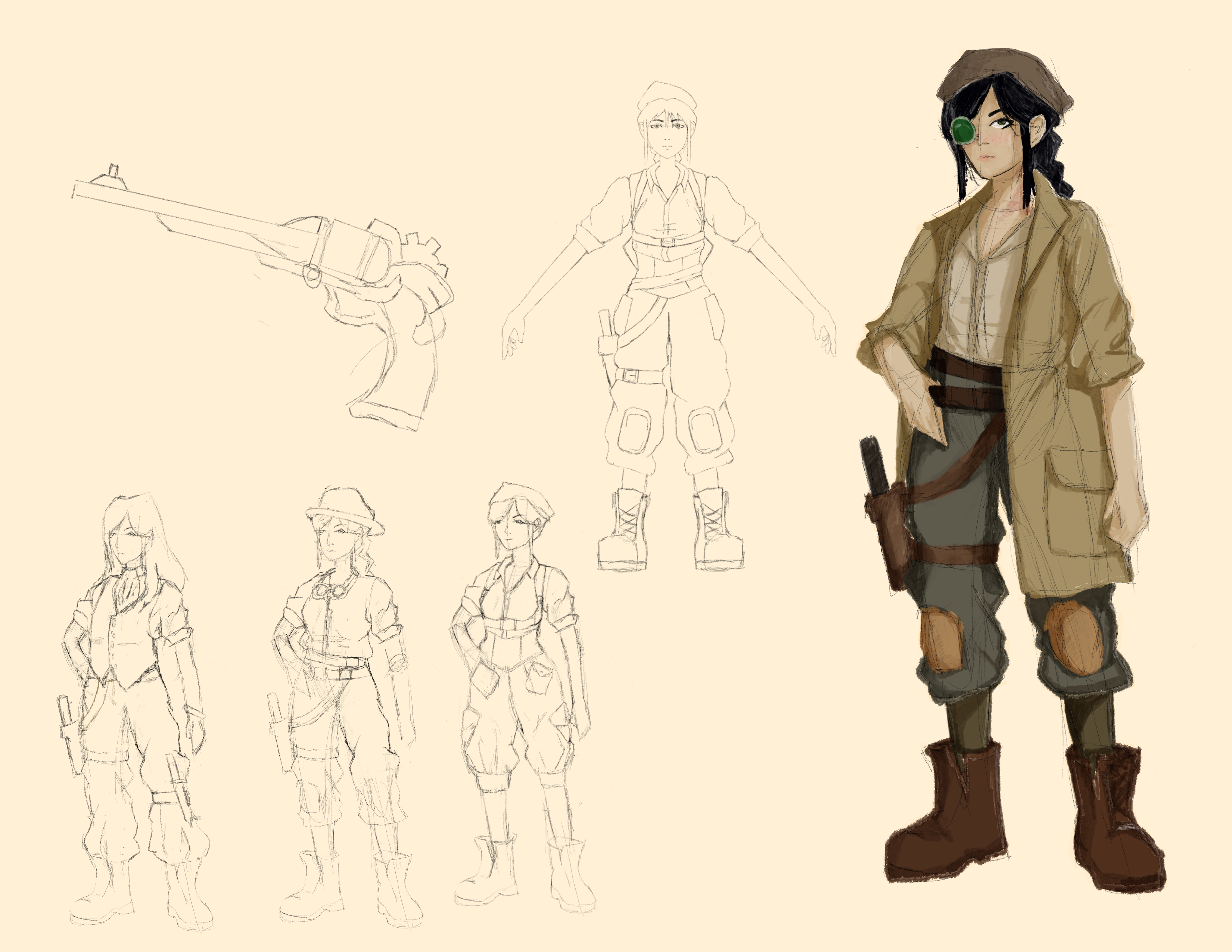
Final
Focus: Character design, narrative context, and portfolio presentation.
Task: Create a Character Design Document that demonstrates your ability to clearly communicate a character idea for your game world. This project brings together your drawing fundamentals, storytelling, and design clarity.
Important
This project is worth 30% of your semester grade. It will take time to complete. Time management is one of the most critical skills in the creative industry — start early and pace your work.
Steps to Completion
Step 1 — Research & References
Collect visual references for anatomy, costumes, props, and mood.
Build a mood board with at least 10 credited images.
Step 2 — Silhouettes & Shape Language
Produce 10–15 silhouettes exploring different shapes and proportions.
Choose 2–3 strong options and refine them.
Step 3 — Anatomy & Costume Sketches
Develop sketches with basic construction lines.
Experiment with outfits, accessories, or props that reinforce personality.
Step 4 — Character Turnaround
Draw at least front, side, and back views. Ensure proportions stay consistent.
Step 5 — Expression & Color Studies
Draw 4–6 expressions to show personality.
Explore palettes; finalize flats with notes on materials or textures.
Step 6 — Final Character Design Document
Compile everything into a single presentation board or PDF.
Include:
- Character bio (150–200 words)
- Turnarounds, expression sheet, and flats
- Mood board and references with credits
- Notes explaining design choices
Deliverables
- Character Bio — 150–200 words describing role, backstory, and personality
- Turnaround Sheet — front, side, back views (3/4 optional)
- Expression & Color Sheet — 4–6 expressions + palette study
- Mood Board — with credited references
- Final Character Document — combined board or PDF
- Portfolio Upload — publish final work and reflection
Design Restrictions & Guidelines
For this project, your character design must be a bipedal humanoid.
This means:
- Two legs and two arms (though they may be missing or replaced with artificial limbs).
- Avoid overly complex features like lots of hair, feathers, or flowing clothing.
- Keep it realistic for a first model — this character will be modeled in Game Art & Design 1, Units 1–3.
A simplistic character does not mean a dull design. Personality, storytelling, and clear design choices matter more than complexity. If you’re unsure about your idea, talk to me early. During the research and reference phase, I will guide you if your design is too complicated for our timeline.
Allowed vs Not Allowed
| ✅ Allowed | ❌ Not Allowed | Why |
|---|---|---|
| Humanoid with two legs and two arms | Creatures with 4+ arms, wings, or tails that require complex rigs | Too advanced for first-year rigging and animation |
| Prosthetics, artificial limbs, or missing limbs | Fully robotic/mechanical exoskeletons with intricate parts | Exceeds modeling time and detail level available |
| Short or tied-up hair | Long, flowing hair or feathers | Cloth/hair simulation is too advanced for beginners |
| Simple clothing (jackets, pants, boots) | Long flowing robes, capes, dresses with folds | Complex cloth modeling & physics outside project scope |
| Basic props (belt, small bag, glasses) | Heavy weapon sets, large armor, wings, or detailed accessories | Takes too long to model and detracts from fundamentals |
| Stylized but readable proportions | Extreme monster forms or quadrupeds (wolves, dragons, etc.) | Requires anatomy/rigging skills we won’t cover yet |
Reminder: Clarity is more important than detail. Your design should be readable enough that another student could model it without asking for extra instructions.
Learning Outcomes
By completing this project, you will:
- Apply character design fundamentals to communicate personality and story
- Practice clarity and proportion in a full turnaround sheet
- Build an expression and color study for emotional range
- Compile a portfolio-ready design document
- Demonstrate professional file management and presentation
Rubric
| Criteria | Exceeds (100%) | Meets (85%) | Approaches (55%) | Does Not Meet (0%) | Value |
|---|---|---|---|---|---|
| Research & References | Comprehensive, well-credited | Complete, clear context | Minimal variety, weak crediting | None | 10 |
| Silhouettes & Sketches | 15+ varied; 3 strong refinements | 10+ with variety | Limited exploration | <5 | 15 |
| Turnaround Sheet | 3+ aligned views; consistent proportions | Front + side views; mostly aligned | Inconsistent or incomplete | None | 20 |
| Expression & Color | 6+ expressions + strong palette study | 4+ expressions + palette | Minimal variety | None | 15 |
| Final Character Document | Polished, labeled, portfolio-ready | Complete, legible | Incomplete or rushed | None | 20 |
| Reflection & Portfolio | Insightful, clear upload | Basic upload | Minimal effort | None | 10 |
| Professional Practices | Correct naming, organized, credits shown | Minor issues | Frequent issues | Disorganized | 10 |
Total Value: 100
Late work: −10% per week. Missing sources: −5. Poor naming: −2.
Example Layouts

Sintel concept art — David Revoy / Blender Foundation — CC BY 3.0

Kiki model sheet — Tyson Tan — CC BY-SA 4.0